

Makachu sport has grown from a leisure activity to local culture – and an opportunity to promote the popular “Spice Island” of Zanzibar.
By Blue Africa News
Nollywood actor Rita Dominic is the latest African celebrity to witness first-hand the thrilling Makachu sport in Zanzibar, with the game cementing its position as one of the top tourists’ attraction ventures in the semi-autonomous Tanzanian Island.
The sport is not for the faint hearted, though. It entails high-stakes acrobatic diving performed by young men from Zanzibar’s Forodhani Gardens seawall into the Indian Ocean, featuring plenty of dramatic and choreographed flips, achieved over years of training.
The Nigerian actress visited Stone Town, Zanzibar and from the number of videos shared on multiple social media platforms, her trip successfully brought widespread attention to the island’s many world-class attractions.
In one of the videos seen by Blue Africa News, the actress is seen sandwiched between the divers holding a banner welcoming her to the Island. “Rita Dominic from Nigeria, welcome to Zanzibar,” the divers chorussed.
In a twinkle of an eye, one of them grabs the banner before diving with it into the Indian Ocean in a trademark Makachu flip, before his colleagues follow it up with daring acrobatic dives that leave their guest awe-struck.
After the flips, Rita and her hosts break into song and dance.
“Wageni, mwakaribishwa, Zanzibar yetu hakuna matata. Nchi ya kupendeza, hakuna matata. Mkiondoka mje tena, hakuna matata,” they sung, translating to “Our guests, you are welcome to Zanzibar where there’s no trouble. A beautiful country, there’s no trouble. When you leave, come back again.”
Witnessing Makachu, she later admitted, was a highlight.
“It was lovely experiencing Makachu. What a lovely welcome. Thanks to my tour guide Hamdua Juma and one of the Makachu leaders, Ofser Abubakar,” she wrote in an online post.
Dominic’s name is one of a growing list of high-profile African guests to have witnessed the sport.
In September 2022, Kenyan Hollywood star and Oscar award winning actress Lupita Nyong’o not only witnessed the thrilling sport, but went a step further by jumping into the Indian Ocean, albeit under a keen eye of the divers, operating under the “Zanzibar Fun Divers” group.
“We did it,” Lupita declared after the feat.
Traditionally done for leisure and fun, reports thechanzo.com, the sport has now become one of the most employed marketing strategies, supported both corporate brands, the government and non-governmental organisations (NGOs) to promote events, slogans or products.
As the sport becomes popular and many people increasingly identify with it, locals say the game “is as old as Zanzibar itself.”
According to 60-year-old Mohammed Hamad Ali, a resident of Stone Town, the sport started long before he was born. His youthful years, he recalled, were characterised by him and his peers entertaining visitors at Forodhani Gardens.
“We did not even start it. It used to be one of the leisures that were hard to resist, when you start it, it becomes very difficult to stop. There is something very addictive about it if I can say,” he said.
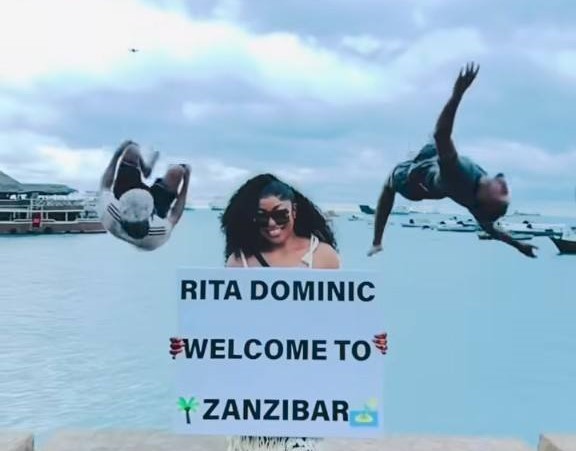
Divers in action during Rita Dominic’s recent visit. Photo courtesy: Rita Dominic
Over the years, the sport has grown from just leisure to promoting culture and an opportunity for the divers to make money out of it.
Reports indicate that besides the normal token of appreciation given to the divers by people who turn up at Forodhani Gardens to witness the action, taking part in one promotional event can earn an individual diver Tsh30,000 (approximately US$11.5).
However, the sport has also had a fair share of controversies.
In December 2024, the Stone Town Conservation and Development Authority temporarily banned the sports over reports of activities contravening Zanzibar’s ethical standards and damage to the area’s infrastructure.
The Authority cited breaches of laws and cultural norms, including performers donning attire inconsistent with local traditions, vandalising drainage systems, and using waste bins as props in their acts.
The ban was later lifted with activities resuming on January 1, 2025. Only performers who agree to adhere to new, strict regulations, including safety guidelines, proper conduct, and compliance with cultural norms are allowed to perform.
Oliver Ochieng, Blue Africa News