

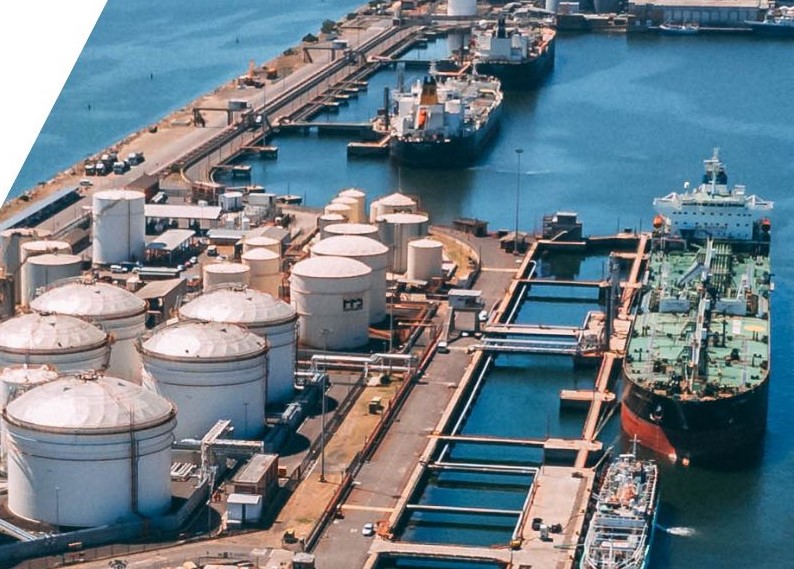
The successful bidder at the port of Cape Town will finance, operate, maintain, refurbish and construct a liquid bulk terminal, including bunkering and related services for a concession period of 25 years.
By Blue Africa News
South Africa’s Transnet National Ports Authority (TNPA) has officially opened the bid submission window for a Request for Proposals (RFP) seeking the appointment of a terminal operator at the Port of Cape Town, one of the busiest in the country.
The Port of Cape Town provides container, bulk, general cargo handling and ship repair services in the Western Cape maritime region, alongside hosting local and foreign fishing fleets, passenger liners, and recreational ships.
Data shows that container logistics chain at the port contributed an estimated R69 billion (approximately $4.2 billion) to the Gross Value Added (GVA) in the Western Cape in 2021, sustaining over 220,000 jobs, with fresh fruit including table grapes, citrus, and apples, and wine being the most important exports.
TNPA in a media statement dated May 07, 2026 said the successful bidder will finance, operate, maintain, refurbish, and/or construct a liquid bulk terminal, including bunkering and related services for a concession period of 25 years.
The RFP allows for private sector participation to enhance liquid bulk cargo volumes at the port, while strengthening bunkering capabilities and revenue generation.
“By attracting a capable terminal operator, we aim to ensure that the site continues to operate efficiently while supporting regional fuel supply and broader economic growth,” said Ophelia Shabane, acting port manager at the Port of Cape Town.
“The RFP is underpinned by demonstrable market demand, which informs the appointment of a new terminal operator to deliver operational efficiency, ensure operational continuity and effectively use and modernise existing infrastructure,” added the acting manager.
The terminal project site is an existing brownfield development comprising of a tank farm with eight storage tanks, offering a combined storage capacity of approximately 44,430 cubic meters including an adjacent storage warehouse and administration building.
The site, says TNPA, allows for the interface with common-user berths at Tanker Basin 1 and Tanker Basin 2, supporting both local supply from the refinery and the importation of bunkering products.
“Through this RFP, the Port of Cape Town seeks to retain and enhance a strategically important liquid bulk terminal, ensuring the continuity of critical services. This also supports long-term financial sustainability and optimal infrastructure utilisation through private sector participation.”
Transnet has over the years been faced with operational inefficiencies affecting the Port of Cape Town and others in the country, negatively impacting South African exporters, particularly those in the agricultural and liquid product sectors.
Financial constraints, outdated equipment and poor productivity have often been cited for the delays, occasioning missed shipping deadlines due to a backlog of shipments.
Transnet is undergoing what is being described as “backdoor privatisation” or “private sector participation,” where private firms are taking over key logistics operations, rail corridors, and port terminals driven by the need for efficiency.
By December 2025 for example, Transnet had completed a partnership with International Container Terminal Services (ICTSI) to operate the Durban Container Terminal Pier 2, a major step toward private participation in port management.
As per the deal, a joint upgrade and development of the terminal between Transnet Port Terminals (TPT) and ICTSI took effect on January 01, 2026, signaling a huge step in the government of South Africa’s economic reforms agenda, and Transnet’s strategy “to crowd in the private sector into selective and strategically identified areas of the business.”
Situated on the east coast of South Africa, Durban Container Terminal is a pivotal hub for the entire Southern African region, serving trade links to the Far East, Middle East, Australia, South America, North America and Europe, while also serving as a transshipment hub for East Africa and Indian Ocean islands.
Oliver Ochieng, Blue Africa News


