Japanese Momoko Kitada is declared winner of the IMO’s gender equality award as research reveals that women represent only 29% of the global workforce in the maritime sector.
By Blue Africa News
Across Africa and the world, women continue to shape the maritime sector both on the frontline and behind the scenes. From aquaculture and seafaring to marine science, port operations, and ocean advocacy, women continue to transform the maritime sector across the globe.
Their growing influence led to the establishment of the International Day for Women in Maritime by the International Maritime Organization (IMO) Council, officially observed every May 18 to celebrate the vital role women play in steering global trade and maritime activities across seas, oceans, lakes and rivers.
Themed “From Policy to Practice: Advancing Gender Equality for Maritime Excellence,” the 2026 International Day for Women in Maritime celebrations saw Japanese Momoko Kitada being declared winner of the IMO’s gender equality award.
Professor Kitada, a maritime academic and former seafarer was recognised for her work in promoting diversity, inclusion and equal opportunities in maritime education and professional development.
She is the Head, Maritime Education and Training at the World Maritime University (WMU) headquartered in Malmo, Sweden. Members of the IMO assessment panel noted that her influence extended far beyond the role she plays at WMU, crediting her for inspiring generations of students to carry forward the principles of gender equality into their own administrations and institutions.
“The panel highlighted the global impact of her work, with her research, teaching and leadership of WMU’s gender and diversity initiatives translating into tangible change in many countries. Bridging academia, policy and practice, Professor Kitada’s quiet leadership style has achieved transformative results for both women and men in the sector, while maintaining a strong and authentic commitment to diversity,” said IMO.
Professor Kitada joined WMU in 2011 and serves as full professor, coordinating and teaching in other Master of Science (MSc) specialisations, including maritime energy management, as well as the postgraduate diploma in maritime energy and the summer academy on maritime decarbonization.
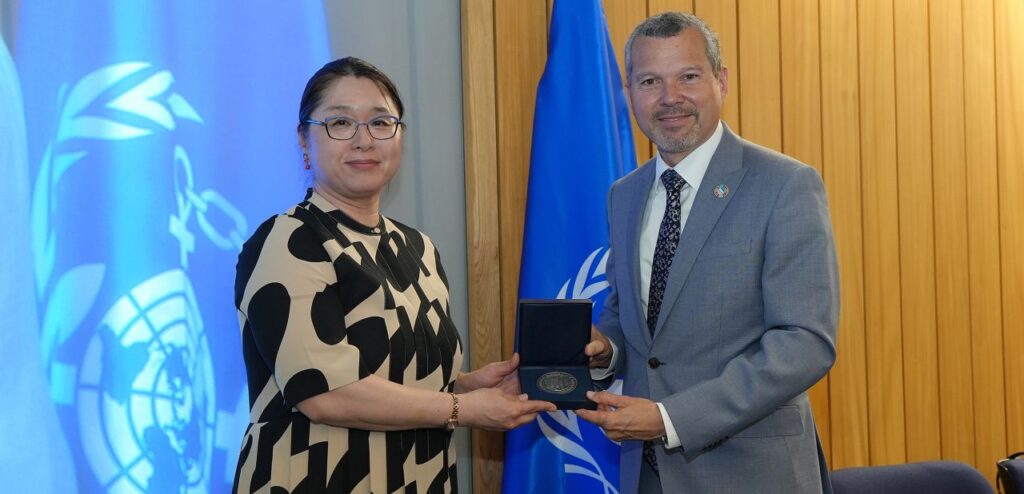
The award was presented to her by IMO Secretary-General Arsenio Dominguez during a ceremony held at IMO headquarters in London, United Kingdom, giving her an opportunity to recount the role her mother played in becoming a seafarer before moving on to become a professor.
“My working-class mother always recognised the indispensable link with education and economic stability, particularly important for women and girls. She pushed me to study hard and be economically independent. Standing here today, I reiterate this encouragement, and encourage all women and girls to invest in education for their personal and professional futures.”
The IMO Secretary-General applauded her contribution to the industry including the publication of her new book “Handbook on Gender Mainstreaming in the Maritime Sector,” which was launched at the event.
“Professor Kitada takes gender balance from aspirational policy to actual practice. We still have some way to go, but it’s people like her, with her quiet determination and decades-long dedication to research, policy development and capacity-building, who will drive the sector’s progress in this area,” said Dominguez.
She becomes the third person to win the award, after Karin Orsel (Netherlands) in 2025 and Despina Panayiotou Theodosiou (Cyprus) in 2024.
Despite the tremendous technological advancement in the maritime sector just like other spheres of life, women’s presence in the maritime sector in Africa and other regions remains limited.
Blue Women Africa.com reports that data from a survey conducted in 2021 by IMO alongside the Women’s International Shipping and Trading Association (WISTA) on women in the maritime sector, shows that women represent only 29% of the global workforce in the maritime sector.
Oliver Ochieng, Blue Africa News