
Tanzania president Suluhu announced the plan is to link Angola’s Benguela Railway with the Tanzania-Zambia Railway (TAZARA) connecting the Lobito Corridor to the Central Corridor and the port of Dar es Salaam.
By Blue Africa News
Tanzania and Angola are exploring plans to connect the Indian and Atlantic oceans through a railway network linking the Tanzania-Zambia Railway (TAZARA) to Angola’s Benguela Railway via Zambia and the Democratic Republic of Congo (DRC).
The proposed connection could give mineral-rich countries in Africa’s Copperbelt region alternative routes to international markets through the ports of Dar es Salaam on the Indian Ocean and Lobito on the Atlantic coast.
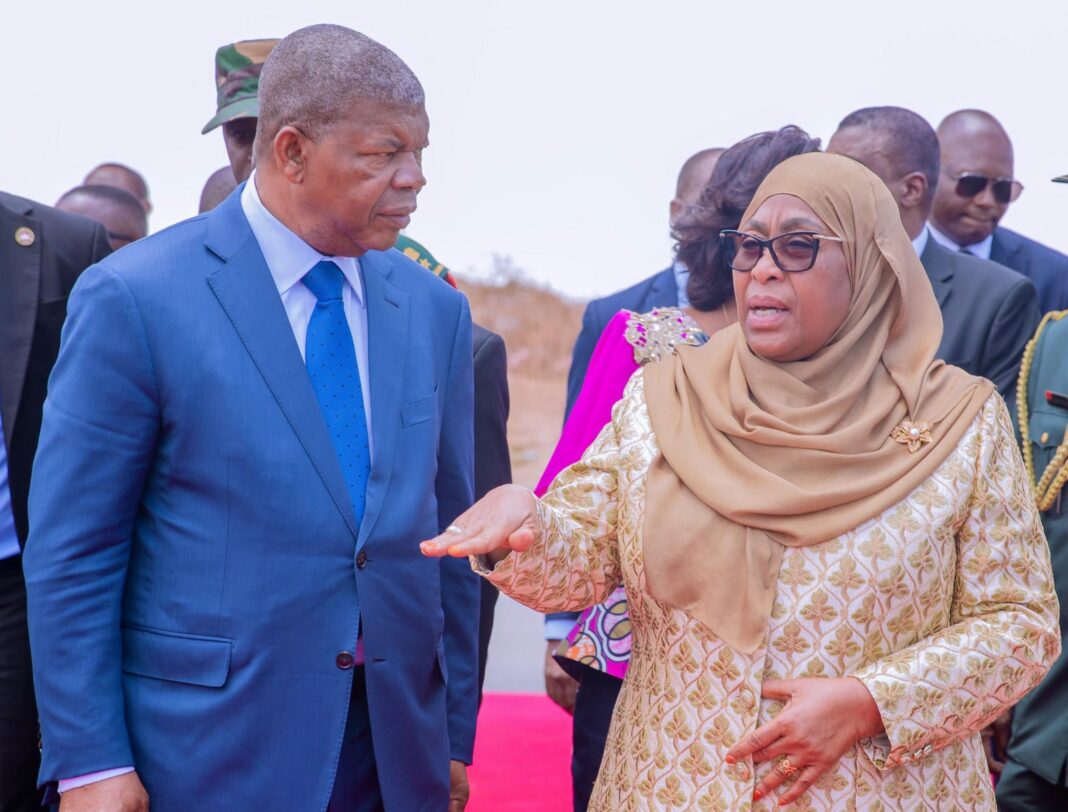
The plan was announced recently when Tanzania president Samia Suluhu Hassan hosted Angolan counterpart João Lourenço in Dar es Salaam and Dodoma, in what was the first state visit to Tanzania by an Angolan president in over 40 years.
President Suluhu said the two countries intend to link the Benguela Railway with TAZARA, connecting the Lobito Corridor to the Central Corridor and the port of Dar es Salaam. However, she did not disclose the project’s estimated cost or implementation timeline.
The proposed connection would require significant infrastructure coordination. Whereas TAZARA runs approximately 1,860 kilometres from Dar es Salaam to New Kapiri Mposhi in Zambia, the Benguela Railway connects Angola’s Atlantic port of Lobito to the DRC, leaving huge gaps to be filled to turn dream into reality.
If realised, the link could strengthen regional trade by giving landlocked Zambia and the DRC access to two major ocean gateways, potentially increasing competition between transport corridors and providing exporters with more options for moving minerals and other commodities to international markets.
However, logistics experts caution that political agreements must be backed by substantial investment, compatible railway infrastructure and efficient cross-border operations.
Elizabeth K, a freight forwarding and logistics expert, said improved railway connectivity could offer Zambia and the DRC, both major mineral-producing economies, more options for transporting copper, cobalt and other commodities to international markets.
This, she said, could allow exporters to compare transit times, transport costs and access to different seaports, potentially improving the competitiveness of regional supply chains.
However, she warned that railway infrastructure alone would not guarantee an efficient trade corridor. Its success, she added, would depend on compatible railway infrastructure and technical standards, efficient customs and border procedures, coordination between railway operators, competitive freight rates, reliable port operations, adequate cargo-handling capacity and sustainable cargo volumes.
“Cross-border infrastructure requires more than political goodwill,” she wrote in a LinkedIn post.
“It requires clear agreements on investment responsibilities, infrastructure ownership, operational control, liability, tariffs, regulatory oversight and dispute resolution. The legal framework must support cooperation between participating countries while providing certainty for investors, operators and cargo owners.”
Jacob Isenberg, an independent dealmaker, said an Atlantic outlet alongside the Indian Ocean would give producers more options while reducing dependence on any single transport corridor. Singling out the potential benefits for the port of Dar es Salaam, he said increased cargo volumes would generate additional demand for cargo handling, storage and logistics services.
However, Isenberg stressed that the commercial viability of the railway connection would depend on more than bilateral agreements. “Rehabilitated infrastructure, compatible rail systems, efficient border procedures, competitive freight charges and, above all, financing will decide whether this becomes commercially viable.”
The Tanzania-Angola initiative comes amid ongoing efforts to rehabilitate and expand the Lobito Corridor, which connects mineral-producing areas in the DRC to Angola’s Atlantic coast.
About a year ago, the United States, through its International Development Finance Corporation (DFC), and the Development Bank of Southern Africa (DBSA) signed a US$753 million loan agreement to support the rehabilitation and operation of the Angolan section of the Lobito Atlantic Railway (LAR).
The 1,739-kilometre railway connects Kolwezi in the DRC to the port of Lobito in Angola, providing an important export route for minerals and other commodities from the Central African region.
LAR currently transports copper, cobalt, sulphur, reagents, fuel, agricultural produce and industrial and commercial goods for mining companies, freight operators and regional traders in Angola and the DRC.
If the proposed connection with TAZARA materialises, the existing Lobito network could become part of a wider transcontinental railway system linking the Atlantic and Indian oceans, potentially reshaping trade and logistics options for the Copperbelt region.
Oliver Ochieng, Blue Africa News