
The Liberian government establishes a national carbon market authority to coordinate participation in carbon markets and climate finance mechanisms.
by Blue Africa News
The government of Liberia has dismissed reports of planning to introduce a carbon levy on international shipping from March 1, 2026, clarifying that emissions from international shipping are regulated under global frameworks led by the International Maritime Organization (IMO).
In response to recent online publications on the matter, the Liberian government clarified that it “does not, and will not,” impose a carbon levy on international ships calling at Liberian seaports.
A carbon levy refers to a tax levied on the carbon content of fossil fuels or taxing other types of greenhouse gas emissions, such as methane by putting a price on emissions to encourage consumers, businesses, and governments to produce less.
“Liberia reaffirms its support to the established international legal frameworks governing greenhouse gas (GHG) emissions from ships through the International Maritime Organization (IMO),” stated a press release by the government.
International shipping, the press release said, operates globally, beyond national boundaries, hence its complex nature. “Consequently, regulating international shipping greenhouse gas emissions has, by longstanding international consensus, been entrusted exclusively to the IMO.”
The government pledged to continue engaging with the IMO and other countries to support the development of globally agreed technical, operational, and market-based measures that are “uniform, just, and equitable, taking into consideration developmental realities.”
Accordingly, the government has established a national carbon market authority to coordinate participation in carbon markets and climate finance mechanisms, under the United Nations Convention Framework Convention on Climate Change (UNFCCC) and the Paris Agreement for nationally determined contributions.
In April 2025, IMO approved net-zero regulations for global shipping, setting mandatory marine fuel standard and GHG emissions pricing for shipping to address climate change.
Touted as the first of its kind in the world, the IMO net-zero framework combines mandatory emission limits and GHG pricing across an entire industry sector. The measures were formally adopted in October 2025, before entry into force in 2027, targeting large ocean-going ships over 5,000 gross tonnages, which emit 85% of the total CO2 emissions from international shipping.
IMO said ships will be required to comply with their annual greenhouse gas fuel intensity (GFI) – that is, how much GHG is emitted for each unit of energy used, calculated using a well-to-wake approach, while ships emitting above GFI thresholds will have to acquire remedial units to balance its deficit emissions, while those using zero or near-zero GHG technologies will be eligible for financial rewards.
Liberia, the only African country holding a category “A,” seat at the IMO Council, has the world’s largest ship registry with over 5,000 vessels sailing international waters, offering the West African nation a unique opportunity to play a leading role in global maritime policy and governance.
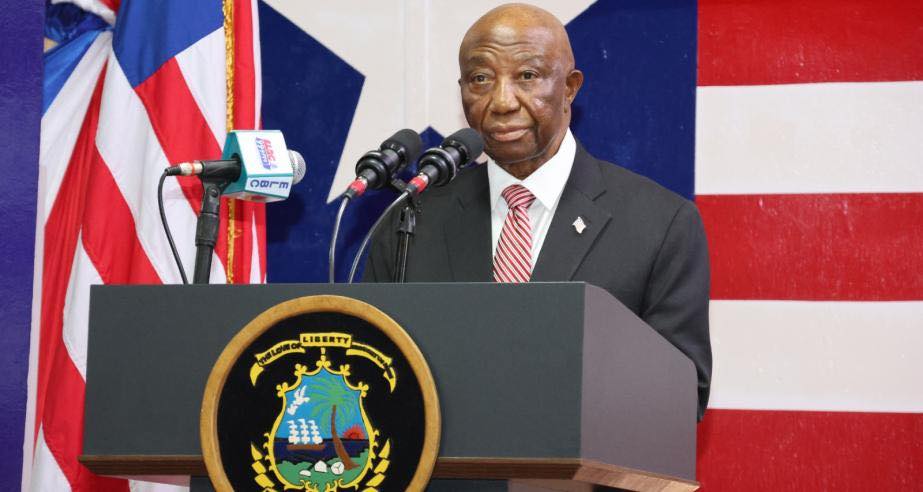
The clarification on alleged plans to introduce a carbon levy comes a few days after president Joseph Boakai, confirmed that his office had returned two port reform bills to the legislature following a formal request from lawmakers.
Passed in 2025, the bills sought to decentralise port operations, modernise infrastructure, and establish autonomous port entities, specifically targeting the Freeport of Monrovia, Buchanan, Greenville, and Harper, focused on dismantling the centralised structure of the National Port Authority (NPA).
The Liberia Sea and Inland Ports Decentralization and Modernization Bill, 2025 and the Liberia Sea and Inland Port Regulatory Bill, 2025 proposed creating a new regulatory authority with broad powers to license operators, set tariffs, enforce compliance, and establish safety standards.
Worker unions and civil society groups raised concerns about transparency and governance, forcing the president to return the pieces of legislation to lawmakers, with the legislatures promising to revise and resubmit the bills within the shortest time possible.
Oliver Ochieng, Blue Africa News