
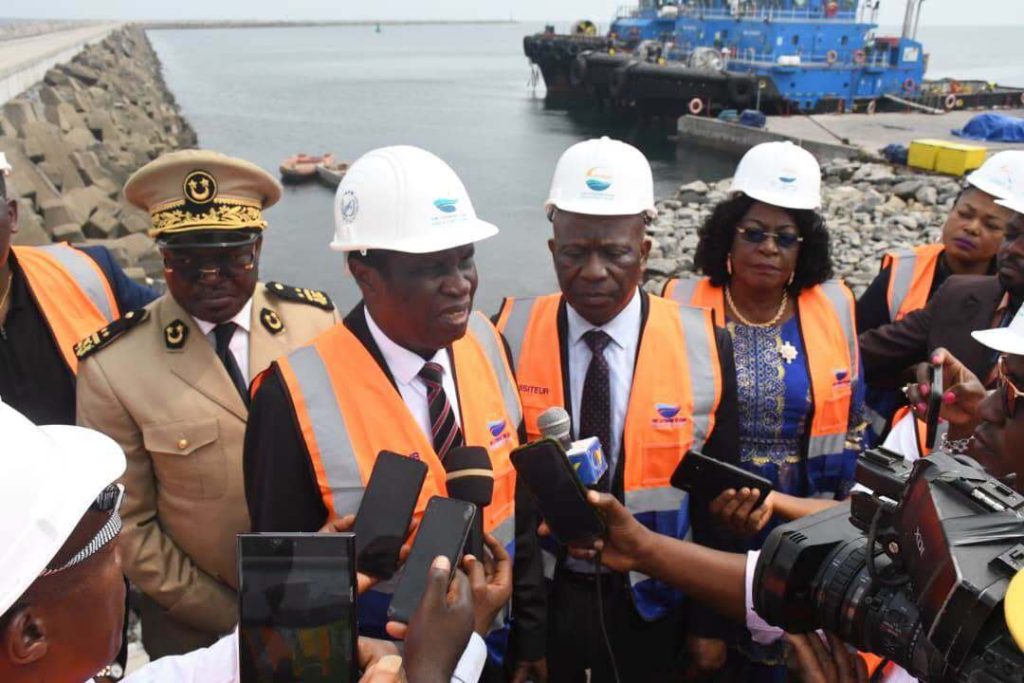
Kribi recently hosted this year’s celebrations of the African Day of the Seas and Oceans, reflecting the strategic role it plays in advancing Cameroon’s blue economy.
By Blue Africa News
The Port of Kribi on July 25 hosted celebrations of the African Day of the Seas and Oceans, an annual calendar event with the host city chosen because of its environmental credentials.
Kribi’s selection as the host city for this year’s celebrations reflected the strategic role the Port Authority of Kribi (PAK) plays in advancing Cameroon’s blue economy. PAK has over the years established itself as a key player by combining port performance, logistics innovation, and the protection of marine ecosystems.
Through a declaration by the African Union (AU) Assembly, the African Day of Seas and Oceans, held jointly with the International Day of the Seas and Oceans, focuses on highlighting the continent’s growing political commitment to promoting sustainable ocean governance, protecting marine ecosystems, and maximizing socioeconomic benefits from aquatic resources.
Speaking during the celebrations, the Director General of PAK, Patrice Melom reaffirmed the institution’s long-term vision of making the port environmentally friendly.
“To make the Port Authority of Kribi a regional benchmark for environmental performance, climate resilience, and responsible governance of maritime spaces,” said Patrice.
This he said, will be achieved through concerted efforts, including initiatives such as promoting the circular economy, sustainable coastal management, and marine environmental protection.
“The Port of Kribi continues to demonstrate that economic growth and environmental stewardship can progress together.”
He said environmental excellence is at the centre of their development strategy, as they focus on contributing to the advancement of a sustainable blue economy for Cameroon and the Central Africa region at large.
The port’s fortunes have been changing gradually owing to investment from the government and multinationals targeting efficient business operations within the region.
In May, the Mediterranean Shipping Company (MSC) expanded its intermodal operations in Cameroon by integrating the Port of Kribi into a door-to-door logistics solution, enhancing cargo connectivity between Cameroon and inland markets across the region – Chad and Central Africa Republic (CAR).
“The solution combines ocean freight, port operations, and inland road transport into a coordinated, door-to-door service, linking Kribi to key destinations including Yaoundé (Cameroon), Moundou (Chad), N’Djamena (Chad), and Bangui (CAR),” MSC said in a statement.
“With up to four weekly vessel calls and direct services connecting Cameroon to Asia including China, Korea, Vietnam, India, and beyond, the integration offers businesses a faster and more cost-efficient way to move cargo.”
Experts say that as trade volumes continue to rise, the use of Kribi strengthens cargo movement across the region and eases pressure on existing trade routes. As Cameroon’s only deep-water port and the largest in Central Africa, Kribi plays an important role in regional trade.
MSC said the expansion was featured in the second episode of its Intermodal Campaign series, building on the first episode highlighting the Abidjan–Ouagadougou rail solution.
In February, a dedicated company was unveiled to oversee the development of an integrated industrial zone at the deep-water port of Kribi.
Kribi Port Industrial Zone (KPIZ) is jointly owned by a consortium comprising the Port Autonome de Kribi (PAK), Africa Global Logistics (AGL), Arise Integrated Industrial Platforms (Arise IIP) and Belmont Investments.
Located in close proximity to the Kribi deep-sea port and covering nearly 4,000 hectares, the Kribi Port Industrial Zone occupies a strategic geographic position, an extensive hinterland into Central Africa, and strong potential for the development of industrial, logistics, port, and tourism activities.
KPIZ is expected to deliver significant economic benefits, ranging from the creation of an estimated 110,000 to 150,000 direct and indirect jobs, a potential contribution of 5% to 8% to Cameroon’s Gross Domestic Product (GDP) by 2040 and strengthening of regional logistics corridors linking Cameroon to Chad, the Central African Republic and Congo.
A Cameroonian delegation is expected to attend the inaugural Blue Africa Conference and Exhibition in Nigeria, this August.
Oliver Ochieng, Blue Africa News


